Managing physical infrastructure across university campuses is highly complex, involving numerous buildings, diverse functions, layered technologies accumulated over time, and constantly changing occupancy patterns. Added to this is another structural factor: the energy footprint of buildings. The building sector accounts for approximately 30% of global energy consumption, and in university campuses, due to their size and diversity of use, this share becomes even more significant.
At the same time, attention toward building digitalization and the integration of digital technologies, monitoring systems, and management platforms continues to grow. It is precisely in dynamic environments such as modern universities that traditional facility management approaches reveal their limitations. Today, a Building Management System (BMS) represents the necessary layer to overcome siloed operations, enable centralized supervision, and transform data into a strategic governance tool for the campus.
How to evaluate the adoption of a BMS in a university campus
To understand whether and how to adopt a Building Management System (BMS), it is useful to start with a few key questions that help assess operational complexity and intervention priorities:
-
Are building systems managed in an integrated way?
-
Is there centralized supervision across campus buildings?
-
Are operational data accessible and usable to support decision-making?
-
Are energy consumptions monitored and optimized in a structured manner?
-
Is the campus capable of scaling and adapting to new operational needs?
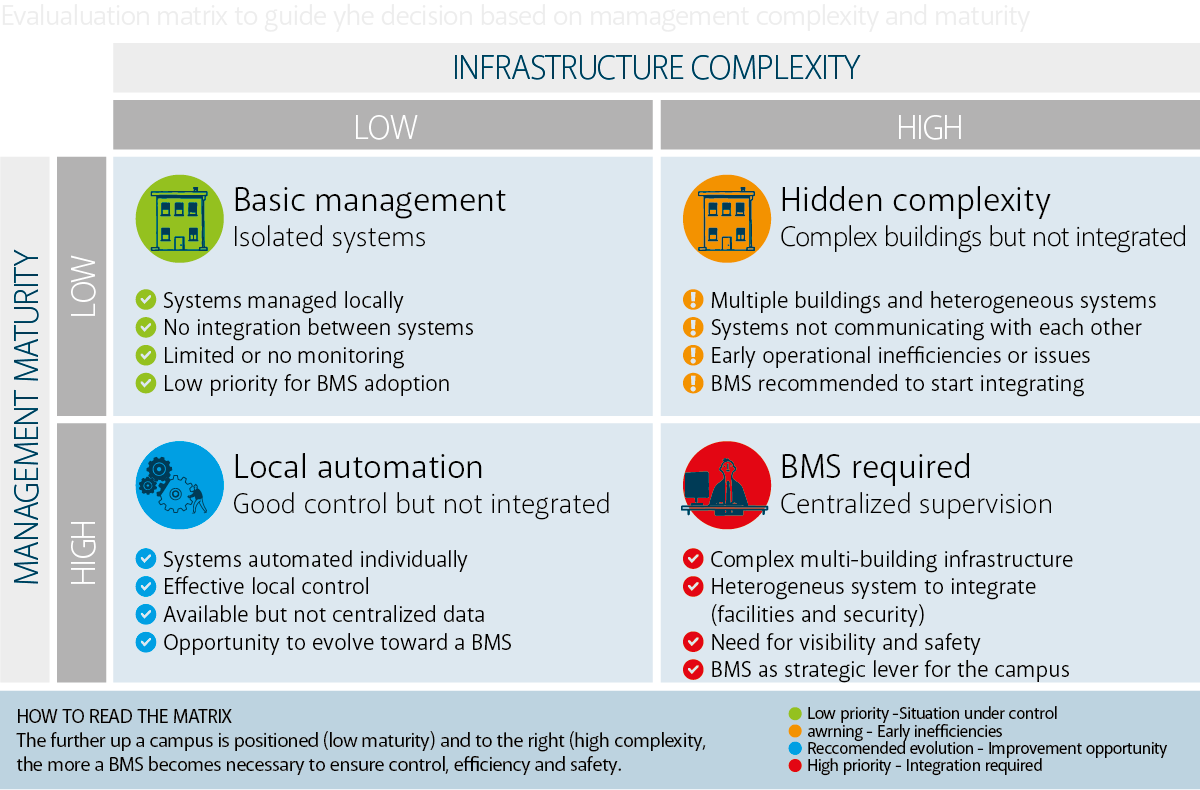
Starting from these questions makes it possible to assess the maturity level of building management and understand the role a BMS can play in the transition toward more efficient, integrated, and sustainable operational models. This guide explores how a Building Management System works, which challenges it addresses, and the key phases involved in implementing it across a multi-building campus.
Takeaways
-
The complexity of university campuses is primarily operational. Heterogeneous buildings, layered infrastructures, and variable occupancy patterns make management based on isolated systems ineffective.
-
A BMS introduces an integration layer. Its value lies in the ability to correlate facilities, security systems, access control, and operational data.
-
Centralized supervision is the real enabling factor. Aggregating information within a single platform improves visibility, response times, and decision quality.

Challenges in managing university campuses
Campus complexity is linked to the number of buildings, the diversity of activities, and technological stratification. Classrooms, laboratories, student residences, libraries, and shared spaces all have different operational and security requirements, yet they are often managed through disconnected systems. In practice, this leads to recurring challenges such as:
-
Uncorrelated alarms generated by different systems, including video surveillance, access control, intrusion detection, and fire safety systems, that do not communicate in an integrated way, making it difficult to quickly understand the real context of an event;
-
Difficulty locating incidents or anomalies, especially across distributed campuses with multiple buildings and large outdoor areas, resulting in delays in verification and intervention activities;
-
Long response times, caused by the need to manually collect information from multiple platforms and by the absence of centralized operational procedures;
-
Lack of decision-support systems capable of contextualizing events, automatically correlating data, and guiding operators in the management of critical situations or emergencies;
-
Absence of a centralized, real-time view of the overall campus status, impacting the safety of students, staff, and infrastructure, as well as the operational efficiency of security and facility management teams.
What is a Building Management System and how does it work in universities?
A Building Management System is a digital platform designed to centrally monitor and manage the main technological systems of one or more buildings, making operational data accessible through a single supervisory interface. From a technological perspective, a BMS is typically structured into three levels:
-
Field level, consisting of sensors (temperature, relative humidity, air quality), actuators, HVAC devices, electrical panel interfaces, and lighting systems;
-
Automation level, where local controllers manage the operation of individual systems;
-
Supervisory level, where the BMS collects, normalizes, and visualizes data through dashboards and graphical synoptics, providing a complete overview of building status and consolidating all operational and technological alarms into a single interface.
Within university campuses, the value of a BMS lies in its ability to correlate operational data and facility behaviors, adapting systems to real usage conditions. This means being able to automatically regulate HVAC and lighting based on occupancy and schedules, maintain controlled conditions in critical spaces, and manage buildings with different usage patterns, such as classrooms and student residences, according to their specific operational requirements.
Guide to implementing a BMS in a university campus
Implementing a BMS in higher education environments is generally more complex and structured than in standard commercial buildings, because it involves large campuses, heterogeneous facilities, and objectives related to energy efficiency, service continuity, and sustainability.
1. Requirements and constraints assessment
The first phase consists of identifying operational priorities. In many cases, these include increasing security (access control, intrusion detection), reducing energy consumption, improving alarm management, or obtaining centralized visibility across buildings. A critical aspect for university operational teams is maintaining an adequate level of operational autonomy, for example in managing graphical layouts, creating or modifying supervisory pages, and configuring key system parameters. This autonomy enables institutions to quickly implement updates, reconfigurations, or functional adjustments independently, reducing reliance on external vendors and associated maintenance costs. At the same time, it helps preserve internal know-how and allows the BMS to evolve according to changing operational needs, such as new space allocations, departmental reorganizations, or the introduction of new systems and infrastructures.
2. Verification of integration with existing systems
A critical factor is the BMS’s ability to integrate with already deployed field systems, including:
-
HVAC systems
-
Lighting systems
-
Security systems
The objective is to build a unified operational view of events, improving response capabilities and operational coordination.
3. Centralization of information
To ensure structured rather than reactive management, the BMS platform enables operators to visualize buildings on maps, monitor system status, manage correlated alarms, and track assets and maintenance activities. In more advanced scenarios, the BMS becomes the core of a centralized operational management model similar to a control room environment. All data, facilities, access control, security systems, and operational information, converge into a single platform, enabling operators to maintain full campus visibility, respond rapidly to incidents, and coordinate interventions effectively.
Benefits of a BMS for universities
Adopting a BMS generates concrete and measurable benefits:
-
Energy efficiency: energy consumption reductions of up to 34%;
-
HVAC optimization: HVAC systems account for up to 70–80% of total energy consumption, with potential savings of up to 55%;
-
Environmental comfort: more stable conditions for students and staff;
-
Operational efficiency: greater control and reduced operational complexity.
From an energy management perspective, a BMS can be highly effective by enabling advanced, data-driven optimization strategies. Specifically, the platform allows organizations to:
-
collect and historize energy data at both building and system level;
-
optimize HVAC and lighting system operations;
-
support demand response strategies and peak load reduction initiatives.
Graphical mapping capabilities also enable rapid localization of systems, events, and devices, improving operational efficiency. In university environments, this capability is especially valuable because it helps reduce waste, improve overall efficiency, and support long-term sustainability objectives.
From fragmented management to integrated campus governance
In university campuses, complexity is not only technological, but also operational. A Building Management System represents the transition from fragmented management to integrated governance.
A BMS is not merely a control tool, but a platform that connects systems, data, and operational decisions, enabling more efficient, sustainable, and informed building management. In this sense, the BMS becomes part of a broader ecosystem capable of connecting infrastructures, data, and operational processes, supporting the evolution toward truly smart campuses that are more efficient, secure, and sustainability-oriented.

-1.jpg?width=352&name=female-guard-pointing-at-cctv-on-screen-2025-03-16-19-39-16-utc%20(1)-1.jpg)