
Large-scale events present significant operational challenges. The entire emergency response system must increase its level of readiness and ensure it can respond effectively to a surge in demand. In highly complex scenarios, such as the Milano Cortina 2026 Olympic and Paralympic Winter Games, it is essential to adopt organizational and decision-making models that minimize operational inefficiencies. Key challenges include managing high call volumes and prioritizing emergencies, dispatching resources efficiently, avoiding overlapping responses, and ensuring optimal coordination across all Emergency Control Centers. A common misconception is that simply increasing the number of available resources (response teams, emergency vehicles, dispatchers, and call takers) automatically improves service quality. In reality, the relationship is not linear.
Effective integration between the 112 Public Safety Answering Point (PSAP), Emergency Medical Services (EMS), and field responders is essential to delivering the expected level of emergency response.
In this article, you'll learn:
-
How 112 and EMS Control Centers operate;
-
How to integrate 112, EMS, and field responders into a unified response system;
-
How to establish an effective chain of command;
-
Why increasing resources alone is not enough to improve emergency response.
Managing emergency response at large-scale events
Large-scale events place exceptional demands on emergency response systems, requiring multi-agency coordination, interoperability, and real-time situational awareness. Ensuring an effective response depends on the seamless collaboration between Emergency Communications Centers (ECCs), field responders, Civil Protection authorities, and other public safety agencies. The 112 Public Safety Answering Point (PSAP) serves as the single point of access for emergency calls, while the Emergency Medical Services (EMS) dispatch center is responsible for medical triage, resource deployment, and operational coordination of pre-hospital care.
Within this response framework, each organization performs a specific mission:
-
112 PSAP receives emergency calls, determines the caller's location, performs the initial call triage, and transfers incidents to the appropriate emergency service.
-
EMS Dispatch Center conducts medical interrogation, prioritizes incidents according to clinical severity, dispatches the most appropriate resources, and coordinates EMS operations throughout the incident.
-
Field responders, including ambulance crews, physicians, paramedics, Civil Protection teams, Fire and Rescue Services, and Law Enforcement Agencies, deliver operational response at the incident scene.
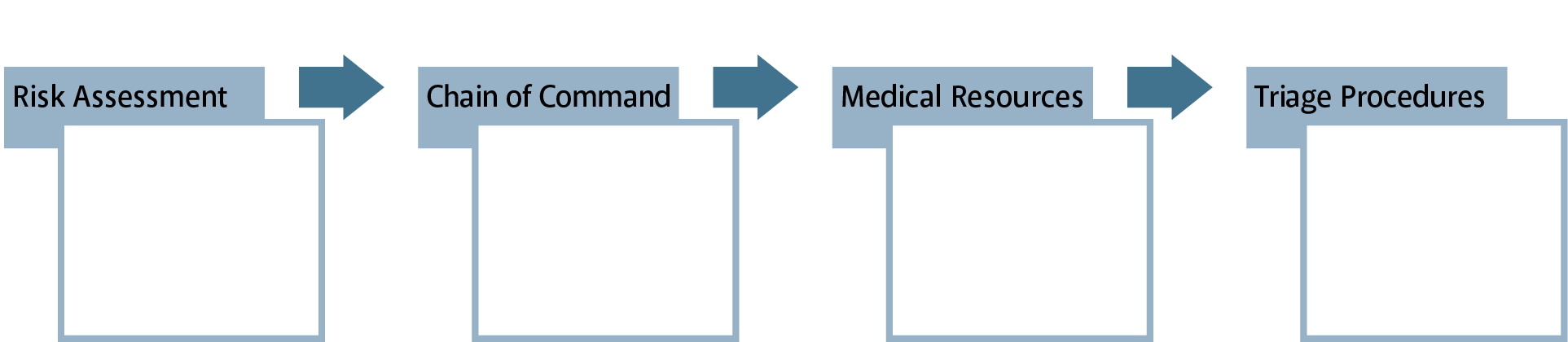
During major planned events, where high call volumes, dense crowds, and complex operational environments significantly increase the likelihood of critical incidents, pre-event planning becomes a key success factor. Building an effective emergency response capability requires several coordinated activities:
-
Risk assessment. Evaluate attendance forecasts, venue characteristics, event profile (sporting, cultural, political, etc.), and potential threats to determine the required level of medical coverage, command structure, and response resources.
-
Establishing a unified chain of command. EMS leads medical operations while coordinating closely with Public Safety agencies, Civil Protection, Fire and Rescue Services, and Law Enforcement under a common operational framework.
-
Deploying Advanced Medical Posts (AMPs) and Forward Command Posts. These facilities provide on-site medical treatment, incident coordination, and tactical command, reducing transport times and improving operational efficiency.
-
Implementing surge triage procedures. When demand exceeds available resources, disaster triage protocols enable rapid patient prioritization by focusing on life-threatening conditions while minimizing administrative overhead.
These components form an integrated emergency response ecosystem, where information flows continuously between the 112 PSAP, the EMS Dispatch Center, and field units. Real-time data sharing improves situational awareness, supports faster and more accurate dispatch decisions, optimizes resource allocation, and ultimately strengthens the resilience of the entire emergency response system during large-scale events.
Why information continuity is critical to 112 - EMS integration
Information sharing is the foundation of an integrated emergency response chain connecting the 112 Public Safety Answering Point (PSAP), the EMS Dispatch Center, and field responders. When information is fragmented, duplicated, delayed, or incomplete, the effectiveness of the entire response can be compromised. To ensure seamless information exchange among the 112 PSAP, EMS, field units, and other responding agencies, organizations should adopt standardized operational models based on two key principles:
-
Information continuity. Data collected by the 112 call taker during the initial emergency call should be transferred electronically to the EMS Dispatch Center and remain available throughout the incident lifecycle. EMS call handlers build on the information already gathered instead of repeating the same questions, enriching the incident record with additional clinical and operational details.
-
Standardized operational language. All agencies should rely on common operational standards, including shared incident priority codes, standardized event classifications (incident type, number of casualties, hazards, etc.), and interoperable incident records containing the same essential data fields. Likewise, voice communications should follow agreed communication protocols to ensure clarity, consistency, and rapid understanding across organizations.
Equally important is joint training and multi-agency exercises involving 112 and EMS personnel. Preparing together for large-scale events helps operators develop a shared operational culture, familiarize themselves with common procedures, and improve coordination and communication during high-pressure incidents. Managing large-scale events is inherently complex. Simply increasing the number of responders, vehicles, or dispatchers is not enough to ensure a more effective emergency response. Success depends on a comprehensive operational strategy built around integrated command and control, accurate resource planning, and continuous information sharing across all agencies involved.