



In 2025, 62% of large Italian companies were using at least one Process Automation technology, while 30% had adopted intelligent automation solutions based on AI. Data from the Intelligent Business Process Automation Observatory of Politecnico di Milano show significant progress, but also the gap that still exists between automating individual activities and intelligently managing complete processes. For utilities, the issue mainly concerns processes that begin with unstructured communications and documents.
A correction request, a billing dispute or a contractual change may arrive by email or certified email (PEC), contain data distributed between the message body and attachments, and require checks across CRM, billing systems, master data and legacy applications. In these cases, automating data entry is not enough: the request must be identified, the information verified, anomalies managed and subsequent activities coordinated. At this point, the combination of RPA + AI evolves into Intelligent Business Process Automation, extending automation from the individual operation to the entire lifecycle of the case.
In this article, you will see how to build a utility process from the receipt of the communication through to system updates and the response to the customer, what role intelligent agents can play and what conditions are required to introduce AI process automation in a controlled and measurable way.
Takeaways
-
IBPA enables utilities to connect unstructured communications, data, rules and enterprise applications within the same process.
-
Automating emails and certified emails requires classification, extraction, consistency checks and anomaly management before CRM and billing systems can be updated.
-
Intelligent agents are useful in variable process steps, where context must be reconstructed and checks across multiple sources coordinated.
-
Process selection must be based on real data, risk levels and KPIs relating not only to speed, but also to processing quality.
RPA + AI in utilities: from task automation to intelligent process management
Robotic Process Automation is designed to automate deterministic, repetitive activities governed by stable rules: a software robot can access an application, retrieve information, populate fields, transfer data and initiate transactions by replicating the operations performed by a user. According to IBM, RPA uses software bots to automate repetitive and time-consuming activities, while Gartner continues to consider it a core technology for improving operational efficiency through task automation. In utilities, RPA is particularly effective for activities based on structured data and stable rules, such as updating master data, recording an outcome or transferring information between the CRM and the billing system; AI extends this scope by introducing content classification, extraction and interpretation capabilities.
However, RPA and AI are not interchangeable: the former executes transactions on systems, while the latter transforms unstructured content into usable information. IBM defines Intelligent Automation as the combination of AI, Business Process Management and RPA.
These components are connected by the workflow, often governed by orchestration components, which maintains the status of the case, manages the sequence of activities, assigns responsibilities, monitors deadlines and determines the conditions for progression. If the request contains all the necessary data and passes the required checks, the process can proceed automatically. If, on the other hand, a document is missing, the reliability level of the extraction is insufficient or the operation has significant financial consequences, the case is assigned to an operator.
It is this integration, rather than the mere presence of a software robot, that defines Intelligent Business Process Automation. For a utility, this means connecting the point at which the request enters the process with the applications that manage customer relationships and billing, while maintaining control over data, exceptions and responsibilities throughout the process. This model is consistent with Beta 80’s offering dedicated to Intelligent Process Automation solutions.
From certified email to billing: how a utility process can be automated
In utilities, an administrative case may begin with a certified email, an email, a digital form or an attachment sent by the customer. The system acquires the communication, retains its metadata and verifies whether a case already exists for the same customer, contract or supply point. The content is then assigned to an operational category, such as a billing dispute, instalment request, change of customer details or meter reading correction. The classification determines the checks to be performed, the responsibilities involved and the applications to be used.
Text and documents are then transformed into structured data. The system can identify, for example, customer code, POD or PDR, invoice reference and disputed amount. Intelligent Document Processing solutions are designed to classify documents and extract information from different formats; the UiPath documentation dedicated to utility bills shows the extraction of data relating to service, consumption, meter and billing.
Before systems are updated, the information is compared with enterprise data to verify its completeness, consistency and reliability. If anomalies emerge or the confidence level is insufficient, the case is routed to an operator together with the original text, attachments and the results of the checks.
Once validated, the request can be recorded in the CRM, checked in the billing system and completed through back-office applications. In the event of a dispute, the process can bring together the invoice, meter readings, consumption, previous corrections and previous communications in a single case file.
The final stage concerns the response to the customer. The system can prepare a communication that is consistent with the status of the case and the outcome of the checks, while corrections, refunds or contractual changes can be submitted for approval.
The aim is to reserve human work for assessments that require expertise, responsibility or exception management.
Intelligent agents in utility processes
Utility processes do not always follow a linear path. Documentation may be incomplete, the data contained in the request may not match the information recorded in the systems, and the same anomaly may require different checks depending on the contract, supply point or customer history. In these cases, intelligent agents can coordinate variable activities that a rigid workflow would not be able to represent in every detail.
Unlike a workflow that follows an already modelled sequence, an agent operates on the basis of a defined objective, selects authorised sources and determines which checks to perform. In a billing dispute, for example, it can retrieve the contract, invoice, meter readings and previous corrections, verify the consistency of the information and prepare a case file for the back office. The outcome may be a proposal or an already prepared case, rather than necessarily an automated decision. IBM defines agentic workflows as processes in which agents equipped with reasoning, planning and tool-use capabilities coordinate activities and decisions.
The same approach is useful for incomplete requests. The agent can identify which information is missing, check whether it is available in other systems and prepare a targeted communication for the customer. When the additional information arrives, it can verify whether the case now contains the elements required to proceed.
The value is particularly evident in processes involving multiple applications, such as CRM, billing, document management and meter-reading management systems. The agent coordinates checks and access to sources, while system changes remain entrusted to authorised components and procedures. Gartner places this evolution within Business Orchestration and Automation Technologies, which combine orchestration, connectivity and agentic capabilities.
Autonomy must, however, be proportionate to the impact of the action. For every use case, it is therefore necessary to establish which data may be accessed, which operations are permitted, when the process must stop and which decisions require approval. Consulting an invoice or preparing a summary presents a different level of risk from changing amounts, contractual conditions or sensitive data.
Logging, access control and source traceability are therefore essential requirements, since the operator must be able to verify not only the result produced, but also the information used and the steps performed. For a utility, agents are particularly useful where it is necessary to reconstruct context and coordinate different checks, without automatically transferring responsibilities that must remain human to the system.
How to design an IBPA initiative for utilities
An Intelligent Business Process Automation project must start from process analysis, not from technology. Automating an individual step may speed up an activity without eliminating delays caused by incomplete data, redundant checks or continuous transfers between departments. The first step is therefore to reconstruct the actual path of the case, identifying input channels, applications involved, manual activities, exceptions and rework points.
Process Mining can support this analysis by using system logs to represent how the process is actually executed. It can identify deviations, bottlenecks and throughput times, helping distinguish problems that can be solved through automation from those that require organisational redesign. IBM points out that Process Mining can guide the selection of automation opportunities and assess their results.
In utilities, the most suitable processes have significant volumes, formalizable rules, accessible data and exceptions that can be classified and managed according to defined criteria. The presence of anomalies does not prevent automation, but it requires a distinction between cases that can be managed through rules and those that require specialist expertise.
Before implementation, it is also necessary to verify data quality: consistent identifiers across customer, contract and supply point, reliable master data and the ability to correlate the information stored in CRM, billing and document management systems. Otherwise, automation risks accelerating the propagation of errors rather than reducing them.
The project must then assign a level of autonomy to each activity that is consistent with its risk. Consulting data, classifying a request, preparing a response and changing an amount cannot be treated in the same way. For each step, access rights, permitted actions, stopping conditions, approval thresholds and responsibilities must be defined.
The pilot phase should also include a controlled share of incomplete or anomalous cases from the outset. A pilot built exclusively around standard cases risks overestimating results and failing to reveal the residual workload on the back office.
The indicators must reflect both process performance and quality:
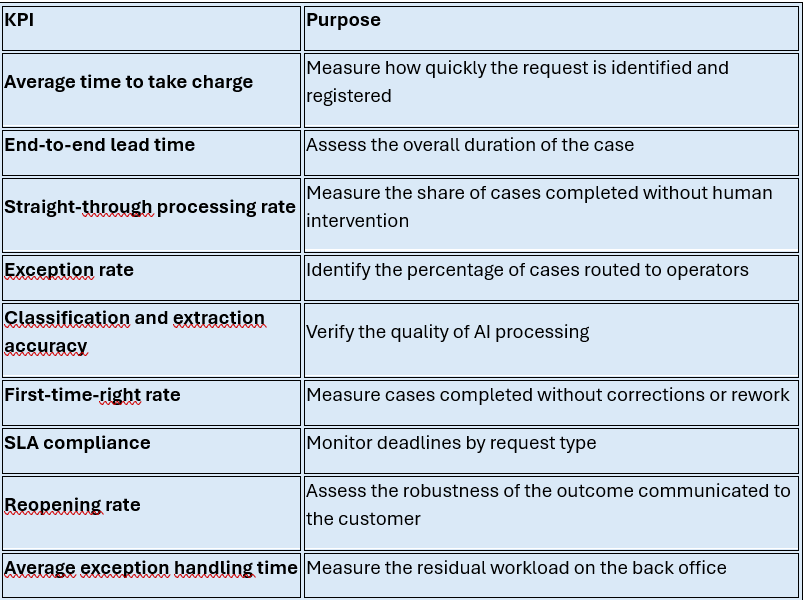
Process duration and cost are basic KPIs in Process Mining systems, but they can be supplemented by customised indicators and thresholds that highlight critical or high-risk activities. For a utility, however, reducing average processing time cannot be assessed separately from accuracy, operational compliance and response quality.
KPIs must also be monitored after deployment, because changes in documents, systems or procedures can alter process behaviour. The objective is to reduce rework, idle time and errors while keeping exceptions and responsibilities under control.
Conclusion
For utilities, combining RPA and AI means rethinking the way a case is acquired, prepared and completed. The value becomes particularly clear in processes that connect unstructured communications with transactional systems: the quality of automation depends on the ability to correctly identify the case, validate the data and execute the required actions without losing the evidence collected.
Intelligent agents extend this model in steps that cannot be reduced to a predetermined sequence. Their use, however, requires explicit operational boundaries, controlled access and clear criteria for transferring the case and the associated responsibility to the operator.
The adoption of Intelligent Business Process Automation must therefore begin with a measurable process, a coherent technological scope and a prior definition of exceptions. In this way, automation can reduce the workload on the back office, improve the quality of case management and make interaction between customers, data and enterprise systems more reliable.