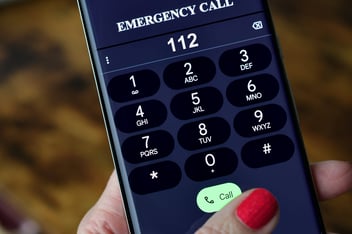
During an emergency call, the quality of communication between the caller and the Emergency Control Room is critical to ensuring an effective response. Several environmental and contextual factors can compromise or limit communication, including language barriers, background noise, or situations in which speaking is impossible due to threat or danger. To ensure efficient emergency response operations, Emergency Control Rooms must receive clear and accurate information. The challenge becomes even more significant when dealing with impaired people: PSAPs (Public Safety Answering Points) must provide adequate communication channels for individuals with hearing or speech disabilities.
In this context, Real-Time Text represents one of the most effective solutions available. Real-time texting enables instant, bidirectional communication accessible both to deaf or speech-impaired users and to anyone facing circumstances where verbal communication is unsafe or impossible.
Takeaways
-
Regulatory requirements for Emergency Control Rooms
-
Why RTT outperforms traditional texting applications
-
Key RTT use cases in emergency communications
-
Future opportunities enabled by RTT
The European Commission Delegated Regulation (EU) 2023/444 establishes a set of measures aimed at ensuring effective access to Emergency Services, with particular focus on the Single European Emergency Number 112. Emergency Control Rooms are required to implement RTT services by 2027, primarily to support individuals with hearing and speech impairments. While accessibility is the core regulatory driver, RTT also represents a major step forward in emergency communications for all citizens. Whenever voice communication cannot take place for any reason, real-time texting becomes a critical alternative. Unlike traditional messaging, RTT transmits text character by character as it is typed, enabling significantly more effective interaction. Real-Time Text eliminates latency and transmission delays, allowing operators to follow events as they unfold in real time on the caller’s device.
Real-Time Text: 3 key use cases
Although RTT technology existed before the introduction of 5G networks, adoption remained limited. The Delegated Regulation specifically refers to RTT within advanced 5G mobile networks and the broader NG112 (Next Generation 112) framework because these technologies significantly improve existing emergency services while enabling entirely new capabilities. More specifically, the Directive requires Emergency Control Rooms to migrate from circuit-switched to packet-switched networks. This transition enables VoIP (Voice over IP) communications and advanced multimedia services. 5G networks provide low latency, high reliability, and substantially greater data transmission capacity compared to previous technologies. RTT is therefore becoming a native component of next-generation emergency communications infrastructures that support multimedia interaction by design.
With its core real-time texting capability, RTT provides an effective solution in three specific scenarios:
-
Threat situations. A “silent call” occurs when speaking aloud could place the caller at risk. In cases such as domestic violence, hostage situations, or criminal activity, silent communication with Emergency Services can be lifesaving. RTT is currently the most effective solution available for these scenarios: communication occurs simultaneously, allowing Emergency Control Room operators to monitor developments in real time and provide immediate instructions.
-
High background noise. Emergency situations are often accompanied by intense environmental noise, such as crowds, alarms, explosions, or general chaos. In these circumstances, RTT enables effective communication when voice conversations become difficult or impossible.
-
Poor voice quality. Text-based communication can also compensate for poor voice transmission caused by weak signal conditions or temporary caller impairments such as stress-induced aphasia or trauma-related speech difficulties. As previously noted, impaired people remain the primary use case identified by the Delegated Regulation. For individuals with limited speech or hearing capabilities, RTT represents the reference technology for accessing Emergency Services.

RTT and the advantages of Total Conversation
Real-Time Text is part of the broader evolution toward advanced emergency communications enabled by 5G and NG112 infrastructures. The increased bandwidth and reliability of next-generation networks allow RTT to integrate advanced capabilities beyond simple real-time texting:
-
Live translation. Language barriers between callers and Emergency Control Room operators remain a significant challenge, especially in areas with high tourist traffic or multicultural populations. Even basic text communication already improves comprehension compared to voice-only interaction, since written communication reduces issues related to accents, pronunciation, and speech clarity. Within 5G-enabled environments, RTT can integrate with real-time translation technologies: messages typed in one language are automatically translated into the recipient’s language in real time. The resulting improvement in communication clarity can significantly enhance emergency response effectiveness.
-
Multimedia Emergency Calls. Directive (EU) 2018/1972 also requires telecom operators to support native multimedia emergency communications, including voice, text, images, and video, as part of the NG112 transition. This approach moves Emergency Services toward the concept of “Total Conversation,” where multiple communication modes coexist within a single emergency interaction. In this context, RTT can be combined with applications that support not only text translation but also voice and video communication.
The implementation of native services by telecom operators and the development of advanced applications by technology vendors are complementary processes that collectively improve Emergency Services quality. Moreover, multimedia communications open the door to a broader integration of social media and digital information sources into emergency management workflows.
The Hrvatski Autoklub Case Study
Across Europe, RTT adoption varies depending on national Emergency Service structures and network infrastructure maturity. In Croatia, for example, HAK Hrvatski Autoklub (the Croatian Automobile Club) is classified as an Emergency Service organization and has implemented RTT to support roadside assistance operations. In a country experiencing steadily increasing tourism flows, real-time texting significantly improves service quality by reducing misunderstandings, improving data accuracy, and enabling faster and more precise assistance. The result is a tangible benefit for tourists and a reputational advantage for the national emergency response ecosystem. HAK Croatia represents an example of native RTT implementation that paves the way for more advanced service evolution.

RTT: from regulatory obligation to strategic opportunity
EU regulations mandate RTT implementation primarily to support impaired people. However, compliance should not be viewed merely as a legal obligation. RTT represents a strategic opportunity to improve the overall quality, inclusiveness, and effectiveness of Emergency Services. This becomes particularly evident in common scenarios such as tourists struggling to communicate with Emergency Control Rooms due to language barriers. Within the broader NG112 vision, RTT is a foundational technology enabling modern, inclusive, and accessible emergency communications capable of supporting all citizens, regardless of their circumstances.